
Here’s why physical installation decisions are the first line of defence in camera security.
In March 2025, Bitsight researchers published findings that should have alarmed every security integrator in the industry. Using nothing more than a standard web browser, they accessed over 40,000 live CCTV and IP camera feeds — no passwords, no hacking tools, no special expertise required. The cameras were simply out there: poorly configured, poorly positioned, and completely exposed.
The conversation that followed focused almost entirely on software: default credentials, firmware updates, network architecture. All of that matters. But there’s a dimension that rarely gets addressed — the role that physical hardware and mounting decisions play in either enabling or compounding these vulnerabilities.
This post maps the six most common CCTV attack vectors identified in government and think-tank research against what proper physical installation and mounting infrastructure can and can’t solve.
What are the most common ways CCTV cameras get hacked?
According to government advisories from CISA and the UK NCSC, and research from Bitsight TRACE, the IoT Security Foundation and IBM X-Force, CCTV and IP cameras are compromised through six primary attack methods:
- Default and weak credentials left unchanged at installation
- Unpatched firmware containing known exploitable vulnerabilities (CVEs)
- Cameras placed on flat, unsegmented networks alongside critical systems
- Unencrypted HTTP and RTSP video streams with no authentication
- Botnet co-option — cameras recruited as anonymous relay nodes
- Pre-positioned malware inserted at state level into camera infrastructure
Each of these has a software dimension. But all six are made significantly worse — and in many cases only happen — because of poor physical installation. Here’s how.
1. Default and weak credentials: an installation problem as much as a password problem
Gardner Brackets for CCTV
The majority of compromised cameras are accessed via factory-set passwords that were never changed. This is fundamentally a setup problem — and setup problems are almost always downstream of installation problems.
When a camera is installed in a difficult-to-reach position, or mounted on a bracket that makes cable management awkward or the device hard to inspect, the installation engineer is under pressure to move on. Credential configuration gets skipped or deferred.
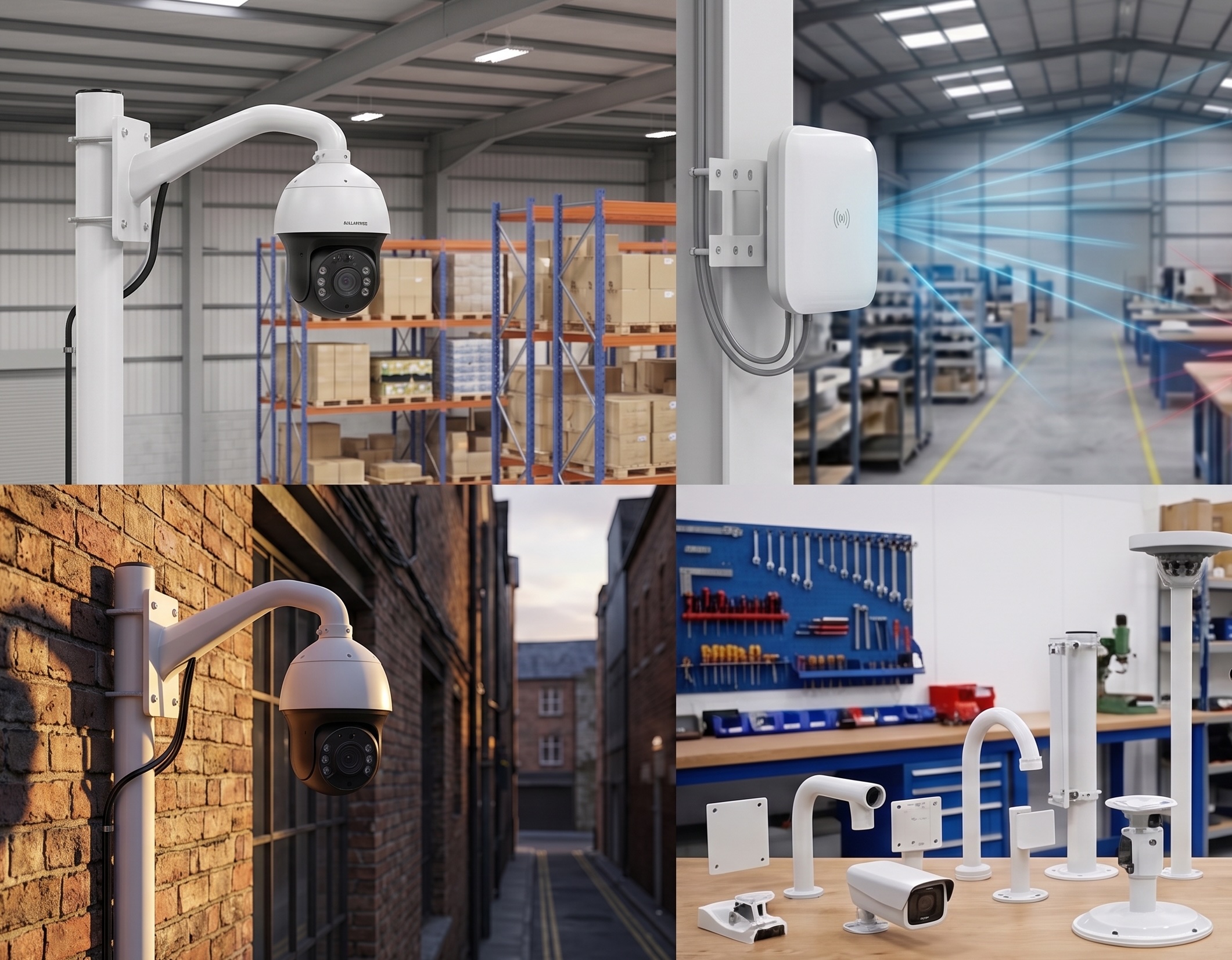
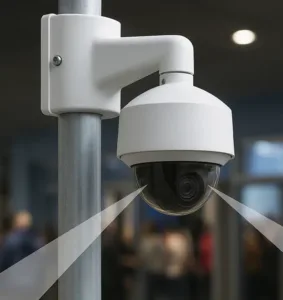
Gardner’s range is designed around clean, stable, accessible installation. The ONPole sliding monitor and camera bracket system allows positioning adjustments along the length of the pole without full reinstallation. The three-step internal ceiling mount system — select ceiling mount, choose pole length, select bracket — is specifically built to make installation straightforward regardless of environment, reducing the pressure that leads to skipped steps.
A camera that’s easy to install properly is a camera that actually gets configured properly.
2. Unpatched firmware: why inaccessible cameras don’t get maintained
The IoT Security Foundation attributes 60% of IoT security breaches to outdated firmware. Cameras running unpatched software are sitting targets — in 2026, Iran-linked threat actors were observed exploiting known Hikvision and Dahua CVEs at scale, with exploitation preceding kinetic missile strikes in the Middle East.
Firmware updates often require physical access to a camera or at minimum a stable, accessible network connection to the device. Cameras that are awkwardly mounted, installed as an afterthought, or positioned where they’re effectively forgotten about simply don’t get maintained.
Gardner’s drop pole system (available in 250mm, 500mm, 750mm and 1000mm lengths) and the fully flexible ceiling mount bracket with tilt and turn capability are designed to give installers and maintenance teams repeatable, accessible positioning. The detachable swan neck design — unique to Gardner’s external range — means the camera head can be removed and replaced without disturbing the rest of the installation, making hardware maintenance genuinely practical rather than theoretical.
3. Cameras on unsegmented networks: how mounting height affects network performance
One of the most consistent findings in IoT security research is that cameras are placed on the same network as critical business systems, with no segmentation. When a camera is compromised, the attacker has a path into everything.
The physical corollary here is signal quality and network performance. The University of Sheffield’s Advanced Manufacturing Research Centre (AMRC) conducted independent testing of Gardner’s mounting brackets against workbench placement across eight locations on a commercial shopfloor.
Results showed that mounting the Wi-Fi access point on a Gardner bracket at 6–8 feet height delivered:
- Lower latency across all test locations
- Higher upload speeds in the majority of locations
- Peak download speed of 247 Mbps vs 69 Mbps at the same location with workbench placement — a 3.5x improvement
Better signal performance gives network administrators a stronger physical foundation for VLAN segmentation and network zoning — the architectural response to flat network risk. It also means cameras are more likely to hold a stable, reliable connection to the correct network segment rather than defaulting to whatever signal is strongest.
4. Unencrypted CCTV streams: a configuration failure with a hardware root cause
A significant proportion of exposed cameras are broadcasting live video over unencrypted HTTP or RTSP protocols with no authentication. Bitsight’s researchers accessed streams via generic URL paths — /out.jpg, /live.sdp, /video.h264 — without attempting any brute-force approach.
This is almost entirely a configuration failure, but configuration failures follow a pattern: they happen when installation is rushed, when cameras are hard to set up properly, and when the people doing the install don’t have the time or support to do it right.
There’s also a subtler point. Cameras that are poorly positioned — too low, obstructed, generating poor image quality — create pressure to reconfigure network settings to compensate. A camera that’s properly mounted, properly positioned, and delivering a clean image on first install doesn’t create that pressure.
Gardner’s range covers every installation scenario: wall-mounted goose necks with NPT1.5 threading, corner mount brackets for awkward junctions, ANPR pole clamp arm brackets for vehicle-facing positions, and swan necks with inline junction boxes for clean cable management. The right bracket for the right position means the camera performs as designed from day one.
5. CCTV botnet attacks: why UK-manufactured components matter
In 2025, CISA and the UK NCSC issued a joint advisory warning that China-linked threat groups Volt Typhoon and Flax Typhoon had built covert networks from compromised IP cameras, using them as anonymous relay nodes to mask espionage activity. The cameras themselves became attack infrastructure.
The hardware response here isn’t a direct one — no bracket prevents botnet recruitment. But the underlying vulnerability is a camera that’s running, connected, and forgotten. Physical infrastructure that makes cameras visible, accessible, and maintainable — properly documented, properly fixed, clearly identifiable — is the foundation for the kind of ongoing network hygiene that prevents devices from going dark and becoming exploitable.
Gardner’s UK manufacturing and bespoke design capability means installations can be specified precisely, with components that integrate cleanly into existing infrastructure rather than being bolted on as an afterthought. Components sourced and manufactured in the UK, with full traceability, also removes the supply chain risk posed by hardware containing embedded firmware from banned entities — a growing concern flagged in 2026 security reporting around Chinese-manufactured surveillance equipment.
6. State-level camera infiltration: what it means for commercial and government installations
In January 2026, it was confirmed that US Cyber Command had pre-positioned malware inside Hikvision and Dahua camera networks across Caracas, Venezuela, creating shadow administrators within the camera infrastructure to monitor President Maduro in real time. Israeli intelligence separately used AI to map movement patterns through Tehran’s urban camera network, providing strike-targeting data.
These are nation-state operations against nation-state targets. The lesson for commercial and government installations below that threat level isn’t about brackets — it’s about the importance of knowing exactly what hardware is in your network, where it is, who manufactured it, and what firmware it’s running. That starts with a physical installation that’s documented, accessible, and built from verifiable components.
Can mounting brackets actually prevent CCTV hacking?
No — and it’s worth being direct about that. No mounting bracket prevents a cyberattack. The threat vectors described above are primarily software and configuration problems: default credentials, unpatched firmware, flat networks, unencrypted streams.
But physical installation quality shapes whether those software problems get addressed. Here’s the practical reality:
- Cameras that are hard to reach don’t get maintained — firmware stays unpatched, credentials stay default
- Access points mounted at floor level or on workbenches deliver inconsistent signal — compounding network segmentation failures
- Installations built from generic, poorly documented components create audit gaps — attackers exploit what you can’t account for
The AMRC study commissioned by Gardner Engineering demonstrated this in measurable terms: proper bracket mounting improved network performance across every key metric — latency, upload, and download — across a commercial shopfloor environment. At some test locations the gap between mounted and unmounted performance was three to four times.
A well-secured CCTV installation starts with hardware that’s built to last, installed correctly, and positioned to perform. Everything else — credentials, firmware, encryption, network segmentation — is built on top of that foundation.
Frequently asked questions about CCTV security and installation
How do hackers access CCTV cameras?
The most common method is simply using default or unchanged passwords. Bitsight researchers accessed over 40,000 cameras in 2025 using standard URL paths with no brute-force required. Other methods include exploiting unpatched firmware vulnerabilities, accessing unencrypted HTTP or RTSP streams, and credential theft via phishing.
Does the height of a CCTV camera bracket affect network security?
Indirectly, yes. Independent AMRC testing found that mounting Wi-Fi access points on brackets at 6–8 feet delivered significantly better signal performance than workbench placement — up to 3.5x better download speeds in some locations. Better signal quality makes proper network segmentation more reliable, which reduces the risk of a compromised camera providing a path to critical systems.
Why does CCTV installation quality matter for cybersecurity?
Cameras that are awkwardly installed or hard to access simply don’t get maintained. Firmware updates get skipped. Default credentials stay in place. Poor physical positioning creates pressure to configure shortcuts that bypass encryption. Installation quality is the upstream variable that determines whether the downstream security steps actually happen.
What is the risk of using Chinese-manufactured CCTV brackets?
Supply chain traceability is an increasing concern in 2025–2026 security reporting. Hardware from manufacturers subject to government bans — including some Hikvision and Dahua products — has been confirmed as a vector for state-level infiltration. UK-manufactured brackets with traceable components eliminate this specific supply chain risk.
What CCTV mounting brackets are best for secure installations?
The best bracket for a secure installation is one that makes the camera easy to reach, adjust, and maintain — reducing the likelihood of skipped firmware updates or inaccessible hardware. Gardner Engineering’s range includes detachable swan necks, adjustable ceiling mounts, drop poles in multiple lengths, and an ONPole sliding bracket system, all manufactured in the UK with full component traceability.