

The security landscape in the UK is shifting. With the introduction of Martyn’s Law (officially known as the Terrorism Protection of Premises Bill) public venues, businesses, and schools are facing a new era of safety responsibility.
In our recent webinar, experts from across the industry discussed what this means for you. The takeaway was clear: compliance isn’t just about buying new “gear”; it’s about ensuring your systems actually work when they are needed most.
Understanding the Tiers
Maryn’s Law is designed to improve preparedness and public safety. The requirements for your organization depend on your capacity and the “tier” you fall into:
1: Standard Tier: Applies to venues with a capacity of 200 or more people.
2: Enhanced Tier: Applies to much larger venues with higher capacity.
3: The School Exception: Notably, all schools fall under the Standard Tier, regardless of whether their capacity exceeds 800. However, this exception does not apply to university or private school estates.
The Security Industry Authority (SIA) has been appointed as the regulator and will be responsible for enforcing these new standards after the implementation period.
Infrastructure: The “Invisible” Critical Layer
A common mistake in security procurement is viewing a camera as a total solution. As Matt Philp from Gardner Engineering noted, “A CCTV camera isn’t a solution, it’s just a device“.
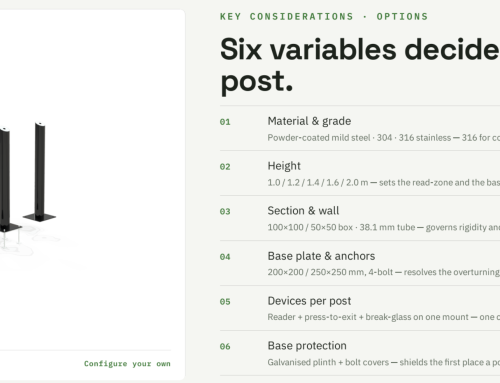
Whether your footage is actually usable in an emergency depends on the physical layer: connectivity, mounting types, angles, and storage. Many organizations undermine expensive hardware with poor placement.
The 2.5-Metre Rule: Through research with Sheffield’s AMRC, we found that mounting access points approximately 2.5 metres from the ground (rather than arbitrary ceiling locations) improved upload speeds by 92% and download speeds by 73%.
By designing for effectiveness rather than just “coverage,” you often need fewer devices while gaining higher resilience.
6 Questions for Strategic Design
When we design mounted systems at Gardner Engineering, we move beyond procurement lists and focus on physical design. To ensure your system is compliant and functional, ask these six questions:
1. Where is the blind spot?
2. What environmental changes affect the line of sight?
3. Where will crowds form?
4. What part of the kit might be tampered with?
5. Where does the network choke under load?
6. How do we scale without a total reinstall?
Outcomes Over Products
The upcoming legislation doesn’t just mandate that you own products; it mandates outcomes. You must be able to prove that every device contributes to fast, accurate, and traceable situational awareness.
Whether it’s implementing lockdown solutions that can connect to third-party fire doors or upgrading vehicle monitoring and perimeter protection, the goal is a cohesive system that acts as a strategic part of your security.