Freight Security Intelligence — June 2026
Europe’s Freight Crime Crisis:
10 Security Failures the Logistics Industry Can No Longer Ignore
Cargo crime is costing European freight and logistics operators an estimated €8.2 billion every year. From deliberately disabled CCTV systems to GPS jamming on France’s motorways, criminal gangs are systematically exploiting the weakest points in the continent’s surveillance infrastructure — and the mounting hardware holding cameras in place is often the first thing to fail.
June 2026 • Sources: TAPA EMEA, University of Sheffield AMRC, TT Club • 12-minute read
Why European Freight Infrastructure Is Failing on Security
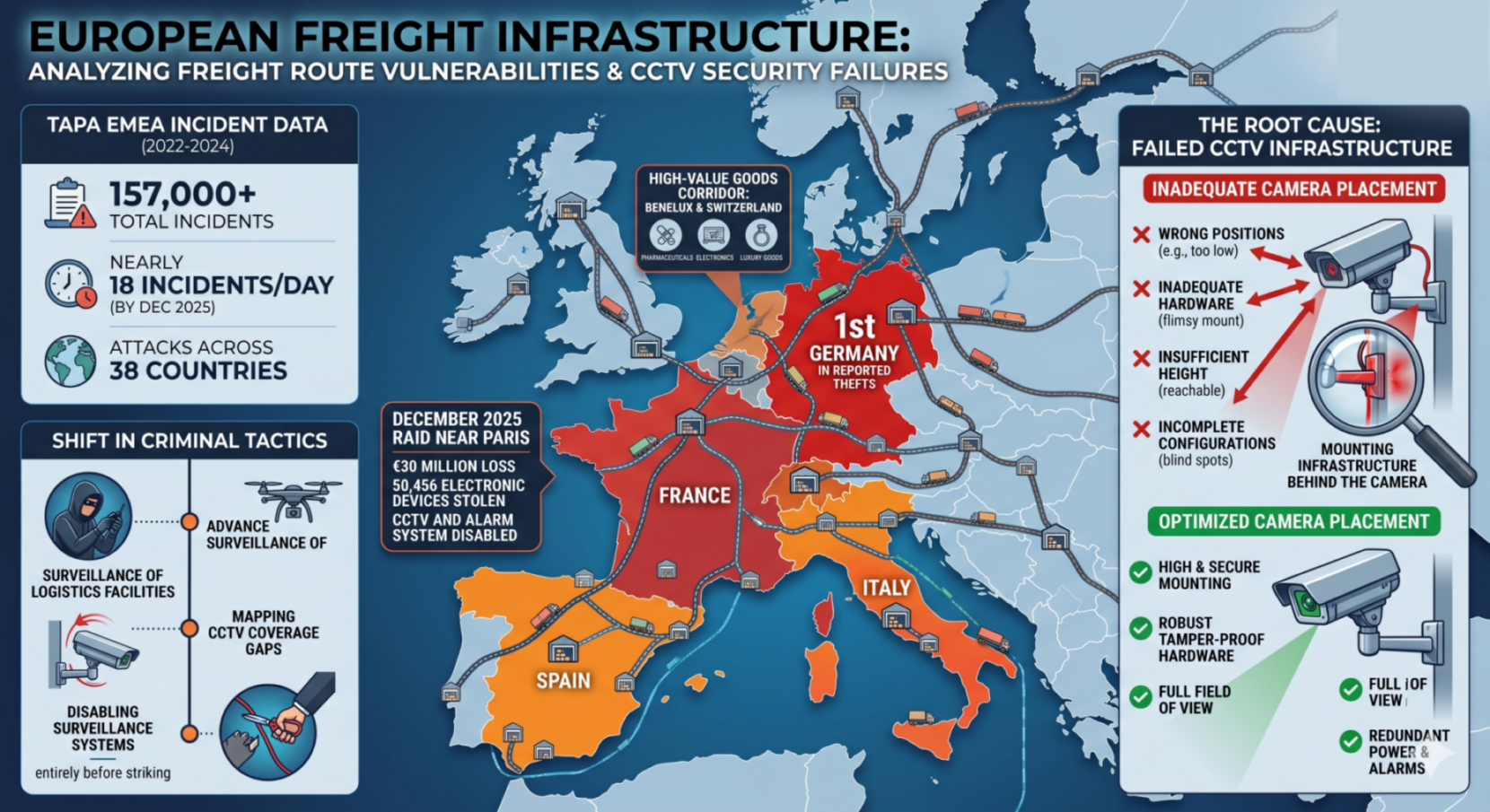
The numbers are stark. TAPA EMEA recorded more than 157,000 incidents between 2022 and 2024. By December 2025, criminal gangs were attacking freight assets across 38 countries at a rate of nearly 18 incidents per day.
Germany leads in reported thefts, followed by France, Italy, Spain — and increasingly, the BENELUX corridor and Switzerland, where high-value pharmaceutical, electronics and luxury goods freight moves through some of the continent’s busiest transit hubs.
The nature of these attacks has shifted fundamentally. What was once opportunistic pilferage has become coordinated, technically sophisticated criminality. Gangs now conduct advance surveillance of logistics facilities, map CCTV coverage gaps before approaching, and in some cases disable surveillance systems entirely before striking.
The December 2025 raid near Paris: 50,456 electronic devices worth €30 million were stolen after the CCTV and alarm system was disabled — is the most high-profile example of a pattern that investigators across Germany, France, the Netherlands, Belgium and Switzerland are documenting with increasing frequency.
The consistent finding across post-incident analysis is not that facilities lacked cameras. It is that cameras were mounted in the wrong positions, on inadequate hardware, at insufficient height, or in configurations that criminal reconnaissance had already identified as incomplete. The mounting infrastructure behind the camera is where European logistics security is failing.
The Hotspot Map: Germany, France, BENELUX and Switzerland
While cargo crime is a pan-European problem, its geography is not uniform. Germany recorded 2,498 cargo thefts in 2023 — more than double the next-highest country — driven by freight concentration along the A1, A2 and A7 motorway corridors and through major logistics hubs at Hamburg, Bremen, Cologne and Frankfurt. The November 2023 incident where 67 trucks had trailers slashed overnight on the A1 corridor illustrates the scale of coordinated rest-area attacks.
France is the second-most affected market, with the Paris Île-de-France region and the Lyon–Marseille corridor as primary hotspots. The January 2026 attack on two trucks carrying €4 million in electronics on a French motorway — involving over a dozen masked men armed with axes — signals a dangerous escalation. In the BENELUX region, the Rotterdam and Antwerp port complexes and the inland terminal networks at Tilburg, Venlo and Duisburg represent critical vulnerability points. Switzerland faces distinct risks at the Basel logistics cluster and along the Rhine freight corridor, where high-value pharmaceutical cargo is a prime target.
What unites all of these markets is the same infrastructure failure: CCTV and surveillance systems not installed at the height, angle or structural integrity the environment demands. That is a hardware specification problem — and it is one that Gardner Engineering is built to solve.
10 Critical Freight Security Failures — And the Mounting Solutions That Address Them
Based on TAPA EMEA 2025–2026 data, University of Sheffield AMRC research commissioned by Gardner Engineering, and TT Club cargo theft reporting
| 01 |
Critical
CCTV Systems Deliberately Disabled at Warehouses and Depots |
19 December 2025 — Dugny, near Paris: Perpetrators disabled CCTV and alarm systems before entering a facility, stealing 30 pallets of electronics — 50,456 devices — with losses estimated at €30 million. TAPA EMEA flagged CCTV neutralisation as a recurring pre-attack tactic throughout 2025.
| › |
Inadequate bracket hardware allows cameras to vibrate loose from alignment in industrial environments, creating coverage gaps that criminal reconnaissance maps in advance of an attack. |
| › |
Consumer-grade fixings used in freight facilities cannot sustain the constant load, temperature variation and vibration from loading equipment that industrial environments generate. |
| › |
Camera drift over time means a system installed correctly on a light-duty bracket will progressively lose its coverage zone — until an incident occurs. |
| › |
Post-incident review in France and BENELUX has repeatedly shown cameras that drifted from their specified positions before an attack, creating the blind spot that was exploited. |
| › |
Adhesive-fixed or impermanent mounts in rental or heritage-listed facilities are particularly vulnerable and are rarely re-inspected after initial installation. |
✓ Gardner Engineering Solution
Gardner’s Heavy Duty Ceiling Mount Pole Brackets (rated to 100kg) and Heavy Duty Girder or Purlin Mount Pole Brackets (rated to 150kg) provide the structural permanence that industrial surveillance demands. For facilities where drilling is prohibited — including rental units, listed buildings and historic freight depots common across BENELUX and Switzerland — Gardner’s adhesive-pad mounting system maintains structural integrity without any surface modification. A camera that cannot be displaced by vibration or forced entry stays on target.
| 02 |
Critical
GPS Jamming Rendering Fleet Tracking Invisible Across European Corridors |
TAPA EMEA, October 2025: Criminal gangs are routinely using GPS jammers to render trucks invisible on fleet management platforms. TAPA EMEA UK Lead: “They’re using jammers to block tracking systems, and deception theft is becoming more common.” Cargo crime now costs European logistics €8.2 billion annually.
| › |
GPS jammers costing as little as €30 can suppress fleet tracking signals across hundreds of metres, making a fully loaded HGV disappear from a dispatcher’s screen in real time. |
| › |
Baltic and Black Sea jamming spillover from military activity has normalised signal disruption across key European freight corridors, lowering the barrier for criminal adoption. |
| › |
France’s motorway network and the A1/A7 corridors through Germany are primary areas where GPS blind spots are actively combined with physical attacks on freight vehicles. |
| › |
BENELUX port environments — Rotterdam, Antwerp — are reporting jamming-assisted diversion of high-value container freight at sea-to-road transition points. |
| › |
When GPS fails, physical CCTV must not: a structurally hardened camera presence at depot entry and exit points becomes the sole verification layer when tracking goes dark. |
✓ Gardner Engineering Solution
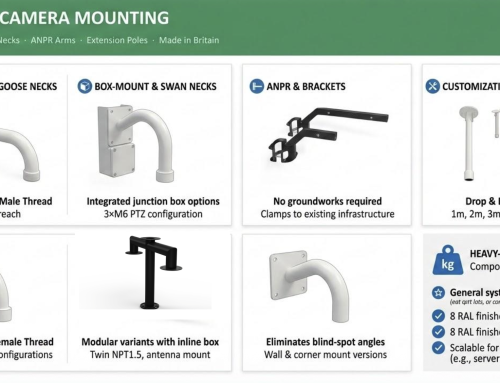
When GPS fails, physical surveillance must be uncompromised. Gardner’s Wall Mounted Goose Neck brackets and Swan Neck camera mounts — with NPT1.5 Female/Male thread fittings and PTZ knuckle grips — position external cameras at optimal height to cover depot gates, trailer bays and perimeters. Gardner’s Drop Pole systems (250mm–1,000mm, with optional side cable entry) deploy cameras at precisely the height needed to capture number plates and driver identification regardless of GPS status.
| 03 |
Critical
Unsecured Rest Areas: Europe’s Open-Air Crime Hotspots on Key Freight Routes |
November 2023 — A1 Corridor, Germany: 67 trucks had trailers slashed overnight across multiple service areas. Germany recorded 2,498 cargo thefts in 2023. By mid-2025, curtain-slashing and lock-breaking accounted for two-thirds of all European freight crime incidents.
| › |
Tens of thousands of lay-bys and truck stops across Germany, France, the Netherlands, Belgium and Switzerland operate with no meaningful CCTV coverage and no perimeter surveillance. |
| › |
Curtain-sided trailers — the European freight standard — can be accessed with a blade in seconds, making unmonitored rest areas disproportionately high-risk environments. |
| › |
TAPA PSR certification covers only a fraction of European truck stop infrastructure; the uncertified majority represents the primary attack zone for organised cargo theft groups. |
| › |
Germany’s A1 corridor and France’s Paris ring motorways have been targeted repeatedly in coordinated multi-vehicle attacks spanning several rest areas in a single night. |
| › |
Switzerland’s alpine transit routes and the E40/E17 BENELUX motorway corridors face equivalent infrastructure gaps at commercial vehicle stopping areas. |
| › |
Installation complexity — not budget — is why cameras are absent: most rest area structures lack conventional wall mounting points, making standard bracket systems impractical. |
✓ Gardner Engineering Solution
Gardner’s ANPR Pole Clamp Arm Brackets (300mm and 490mm outreach) and ONPole Mount Universal Brackets (97, 108, 123 and 145mm diameter variants) enable camera deployment on lighting columns, signage poles and security masts without structural modification — exactly the environment found at European motorway rest areas. The Universal NPT 1.5 Threaded Adaptor and full pole clamp range cover the complete spectrum of standard European infrastructure poles.
✓ Independent Research — University of Sheffield AMRC, March 2025
What Happens When You Mount Surveillance Equipment at the Right Height?
Gardner Engineering commissioned the Advanced Manufacturing Research Centre (AMRC) at the University of Sheffield to test the real-world performance of its mounting bracket systems in a live industrial environment. The AMRC tested Wi-Fi access points on Gardner brackets at 6–8 feet versus workbench placement at 1 metre, measuring ping latency, upload speed and download speed across eight distinct shopfloor locations.
The conclusion: “The mounting bracket designed by GE is suitable for utilising the optimal network performance of the APs.” The system was also installable without drilling, using existing structural elements. The same principle applies to CCTV: equipment mounted at the correct height, on correctly rated hardware, performs measurably better than equipment installed at floor level for convenience.
|
| ~15xUpload speed improvement bracket vs workbench |
247 MbpsPeak download speed via bracket mount |
8 / 8Test locations where bracket beat workbench |
ZeroDrilled holes required for installation |
| 04 |
High Risk
Wi-Fi Dead Zones Creating Connectivity Failures That Take CCTV Offline |
| › |
Real-time CCTV feeds, RFID tracking and live alarm systems all depend on wireless connectivity — when the Wi-Fi fails, monitoring fails regardless of how well cameras are positioned. |
| › |
Access points placed at floor level or on workbenches create dead zones in exactly the high-bay areas and loading dock zones where freight crime most frequently occurs. |
| › |
AMRC testing confirmed that Wi-Fi access points at 1 metre height delivered upload speeds as low as 6.3 Mbps at key locations — versus 82 Mbps for the same equipment on a Gardner bracket at 6–8 feet. |
| › |
Large distribution centres in the Netherlands and Belgium, with ceiling heights of 10–15 metres, are especially vulnerable to floor-level wireless infrastructure. |
| › |
Connectivity dropout during a theft event is the window that organised crime groups rely on to move goods without live CCTV coverage. |
✓ Gardner Engineering Solution — AMRC-Validated
Gardner’s Steel Drop Pole systems (1m, 2m and 3m sections, coupled to a maximum of 9m) allow Wi-Fi access points and CCTV cameras to be elevated to the height required for continuous coverage in any industrial setting. The AMRC independently validated that bracket-mounted access points outperformed workbench-placed units at every single test location.
| 05 |
Critical
Phantom Carrier Fraud: The €200,000-Per-Incident Deception Surge |
Germany, first seven months of 2025: 88 phantom-carrier fraud cases — as many as in the entire previous year — with the average loss climbing to nearly €200,000 per incident. Criminals clone vehicle plates, falsify documentation and collect loads where CCTV coverage is inadequate.
| › |
Phantom carrier fraud depends entirely on the absence of reliable visual verification at collection points — a criminal who impersonates a haulier without being captured on camera faces minimal risk. |
| › |
ANPR cameras at incorrect angles or insufficient height fail to read plates reliably, turning an apparent security asset into a data gap at the exact moment it is needed. |
| › |
Loading bays and depot gates in Germany and France are the primary exploitation points, with post-incident analysis repeatedly showing camera positions that failed to capture the fraud vehicle. |
| › |
In Switzerland, pharmaceutical cargo is the primary target for fraudulent collection, with the Basel logistics cluster an identified hotspot for this crime type. |
| › |
A single missed number plate capture is enough to undermine a police investigation and prevent prosecution across European jurisdictions. |
✓ Gardner Engineering Solution
Gardner’s ANPR Pole Clamp Arm Brackets (300mm and 490mm outreach lengths) are designed for number plate capture, with dimensions calibrated for vehicle approach sightlines. The Fully Flexible Ceiling Mount Bracket with Tilt and Turn (rated to 50kg) provides full-axis adjustment for clean plate reads at any bay configuration. Combined with Gardner’s Inline Junction Boxes, these systems support audit-grade ANPR deployments that produce court-admissible evidence.
| 06 |
High Risk
Insider Theft: 20% of European Cargo Crime Has Internal Participation |
BSI / TT Club Cargo Theft Report: Europe recorded 20% insider participation across all cargo theft incidents. Internal theft accounts for an estimated 40% of UK logistics shrinkage alone. The pattern is consistent across Germany, France and BENELUX distribution networks.
| › |
Insider-facilitated theft is the hardest category to detect precisely because perpetrators have legitimate access — comprehensive internal camera coverage is the primary countermeasure. |
| › |
High-bay racking zones, loading dock corridors and inventory stations are the primary internal locations where stock is diverted, and the most frequently under-monitored. |
| › |
Wall-mounted cameras at standard height cannot cover the interior volume of large logistics facilities with 8–15 metre ceilings, creating structural blind spots insider theft networks exploit. |
| › |
In BENELUX distribution hubs, high turnover of temporary staff across shift patterns significantly elevates insider risk above average freight facility levels. |
| › |
Post-incident CCTV review regularly reveals that stock was diverted from within a structural dead zone — outside camera coverage despite nominal inclusion in the security plan. |
✓ Gardner Engineering Solution
Gardner’s ONPole Mount VESA Sliding Monitor Mount combined with the ONPole Mount Box Camera Bracket (1/4″ knuckle connection) enables internal coverage configurations impossible with wall-mounted systems. Where facilities have existing structural pipework or overhead gantries, Gardner’s clamp-fit systems deploy internal-facing cameras without modification. The Ceiling or Cable Tray Mount Pole Bracket (rated 50kg) suits the overhead cable management infrastructure standard across European freight facilities.
| 07 |
High Risk
Cross-Dock Handover Blind Spots: Risk at Every Custody Transfer |
| › |
A container discharged in Rotterdam may pass through five separate operator environments before reaching southern Germany — with accountability shifting at every transition and CCTV coverage inconsistent across each one. |
| › |
Cross-dock hubs prioritise velocity over surveillance: security oversight relies on process compliance rather than physical camera monitoring, leaving transfer zones effectively unmonitored. |
| › |
Tilburg, Venlo and Duisburg inland terminals — critical BENELUX-to-Germany corridor nodes — handle enormous volumes through transfer areas repeatedly identified as blind spots. |
| › |
Freight that disappears at a handover point is often not discovered until the end recipient raises a discrepancy, by which time footage retention windows have expired. |
| › |
Basel cross-dock facilities and Rhine corridor sites in Switzerland face additional complexity from international customs transitions creating further accountability gaps. |
| › |
EU AEO documentation requirements are tightening chain-of-custody demands, but physical camera coverage at transfer zones consistently lags behind compliance requirements. |
✓ Gardner Engineering Solution
Gardner’s ONPole Mount Universal Brackets (97–145mm diameter variants) enable rapid camera deployment on utility poles, lighting columns and gantry supports at cross-dock transfer zones without structural works. Available in eight RAL colour options including Anthracite Grey and Off-White. For outdoor transfer zones, the Wall Mounted Goose Neck range provides weatherproof external camera mounting with full PTZ knuckle compatibility.
| 08 |
High Risk
Control Room Monitor Infrastructure: The Overlooked Security Weak Link |
| › |
Security monitoring is only as effective as the operator’s ability to see camera feeds — monitors at wrong angles or on consumer-grade fixings degrade the effectiveness of even a well-designed camera network. |
| › |
Multi-screen control room configurations are frequently installed on hardware not rated for continuous load, creating risk of mount failure during critical monitoring windows. |
| › |
Glare, poor viewing angles and inadequate ergonomics mean operators on long shifts miss live events on screen that require immediate intervention. |
| › |
Desk-stand or incorrectly wall-mounted monitors at major BENELUX and German logistics hubs have been identified in audits as a systematic weakness in the monitoring chain. |
| › |
A correctly specified, weight-rated monitor mount is one of the most cost-effective security investments available — and consistently among the most overlooked. |
✓ Gardner Engineering Solution
Gardner’s Heavy Weight Dual TFT Monitor VESA 75/100 Mount with Twist Option (rated 50kg, supporting VESA 75, 100, 200 and 400) enables multi-screen control room setups on Gardner’s pole systems with full vertical and horizontal orientation. The Clamp Style Monitor Bracket (rated 15kg, 38mm pole or box section up to 38x50mm) provides flexible desk-edge and gantry-mounted positioning. All monitor mounts integrate with the full Gardner drop-pole and ceiling-mount range.
| 09 |
Critical
Incendiary and Hybrid-Warfare Attacks on European Logistics Infrastructure |
March–July 2024: Coordinated incendiary device attacks struck DHL freight centres and logistics facilities across England, Poland, Latvia, Lithuania and Germany, attributed to a Russian-linked network. European logistics infrastructure is now a confirmed target for hybrid-warfare disruption — not only economic crime.
| › |
Incendiary attack patterns specifically target the gaps between CCTV coverage zones — the dead angles between camera fields of view that inadequate mounting positions create at building perimeters. |
| › |
Post-incident analysis of the 2024 attacks found surveillance systems that recorded events but failed to trigger real-time alerts or covered too limited an area to identify the perpetrators. |
| › |
Perimeter security at European logistics facilities must now be designed against a threat model including motivated political actors, not only opportunistic economic criminals. |
| › |
Corner mounting failures — building corners left unmonitored because standard bracket systems cannot position cameras at the required angle — are the primary gap exploited in perimeter attacks. |
| › |
Baltic states logistics infrastructure, including facilities in Latvia and Lithuania targeted in 2024, faces ongoing hybrid threat exposure requiring perimeter surveillance that eliminates every angular dead zone. |
✓ Gardner Engineering Solution
Gardner’s External Camera Mounting range — wall-mounted and box-mounted goose neck brackets, corner mount configurations, junction box assemblies and the full swan neck range — is engineered for perimeter coverage in hostile outdoor environments. The Corner Mount Junction Box and Goose Neck combination eliminates angular blind spots at building corners. The Swan Neck With Antenna Mount combines camera and wireless hardware in a single weatherproof installation, reducing fixings required for complete perimeter coverage.
| 10 |
Systemic
The Installation Barrier: Cameras Deployed Where They Can Be Fitted, Not Where They Need to Be |
| › |
The consistent finding across European cargo security audits is not that facilities lack surveillance budget — it is that cameras end up in positions dictated by installation convenience rather than coverage requirement. |
| › |
Facilities that cannot be drilled — rental units, listed buildings and heritage freight depots common across France, Germany and Switzerland — frequently end up with no cameras in key positions because the correct hardware has not been specified. |
| › |
Structures without conventional wall mounting points — open-sided freight yards, covered truck parks, cross-dock transfer areas — leave security planners without a path to optimal camera placement. |
| › |
Multi-ceiling-height environments in BENELUX distribution parks, where heights reach 10–15 metres, exceed the capability of standard-length pole systems. |
| › |
A camera on a 1.8-metre wall bracket at shoulder height is the minimum viable surveillance — visible, gameable by any criminal who has done five minutes of reconnaissance. |
| › |
Criminals conduct advance reconnaissance and identify camera coverage gaps as a primary part of that process — installation convenience creates predictable, exploitable blind spots. |
✓ Gardner Engineering Solution
Gardner Engineering’s three-step specification model — select ceiling mount, select pole length and finish, select bracket type — covers every combination of environment and equipment from a single Made in Britain range. Steel poles in 1m, 2m and 3m sections, coupled to a maximum of 9m, address ceiling heights that standard systems cannot reach. The entire system — from heavy girder mounts rated to 150kg to lightweight cable tray brackets at 50kg — carries independently verified weight ratings, giving security managers and specifiers across Germany, France, BENELUX and Switzerland certainty that hardware will perform as specified for the full life of the installation. Precision mounts. Built to last.
The Infrastructure Behind the Camera Determines Whether It Works
Europe’s freight security failure is not primarily a technology problem. The cameras exist. The access points exist. The monitoring platforms exist. What fails — consistently, across warehouses near Paris, truck stops on the A1, cross-dock hubs in Rotterdam and Antwerp, cargo depots in Frankfurt and Basel — is the physical infrastructure that determines whether surveillance hardware can actually do its job.
A camera mounted at the wrong height misses number plates. A camera on an inadequate bracket drifts out of alignment over time. A Wi-Fi access point at floor level creates dead zones in exactly the areas where CCTV feeds must be transmitted in real time. A CCTV system that criminals can disable in minutes — because it was installed for convenience rather than resilience — is not a security system. It is a record of what happened after the fact.
Gardner Engineering manufactures the mounting systems that close that gap. Every product is Made in Britain, independently weight-rated, and available in a full specification covering every installation environment — from historic freight depots in France where no drilling is permitted, to open-sided motorway facilities in Germany where no wall exists, to the high-bay distribution parks of BENELUX and the pharmaceutical logistics hubs of Switzerland. The AMRC has independently validated what Gardner installers have known for decades: get the mount right, and every piece of equipment attached to it performs better.
Key Products for Freight and Logistics Security
Full product specifications at gardnerengineering.co.uk/products — or call 01772 504234 to discuss your installation requirements.
Heavy Duty Girder / Purlin Mount
Rated to 150kg. For industrial and freight facilities with exposed structural steel. No wall attachment required.
|
ANPR Pole Clamp Arm Brackets
300mm and 490mm outreach. Designed for number plate capture at depot gates and vehicle entry points.
|
Swan Neck & Goose Neck Range
Wall, box and corner mount variants. NPT1.5 threading and PTZ knuckle compatibility. Outdoor-grade.
|
Drop Pole & Extension Pole Systems
250mm–1,000mm NPT extension poles and steel drop poles with side cable entry option. Max 9m.
|
ONPole Universal Mount Brackets
Four diameter sizes (97–145mm) for clamp-fit deployment on existing poles, columns and structural members.
|
Dual TFT Monitor Mount VESA 75/100/200/400
Rated 50kg. Vertical and horizontal twist. For security control room multi-screen configurations.
|
Precision Mounts. Built to Last.
Specify the Right Mount for Your Freight Security Installation
Every freight facility in Europe has a unique structure, threat profile and equipment configuration. Gardner Engineering’s team can help you specify the correct bracket system for your environment — whether you’re securing a single depot or upgrading a network across Germany, France, BENELUX or Switzerland.
Contact the Sales TeamView Full Product Range
SEO & AEO Reference — Yoast / Rank Math Fields
Focus KeyphraseCCTV camera mounting brackets freight security
Secondary Keyphrasescargo crime CCTV Europe 2025 • camera bracket logistics • freight security Germany France BENELUX • CCTV mount Switzerland • ANPR bracket freight depot • GPS jamming logistics CCTV • Made in Britain CCTV brackets
Meta DescriptionEurope’s freight crime crisis costs €8.2 billion a year. Discover the 10 biggest CCTV and logistics security failures across Germany, France, BENELUX and Switzerland — and how Gardner Engineering’s precision-engineered camera mounting brackets close the gaps. Made in Britain. AMRC-validated.
URL Slug/european-freight-security-cctv-camera-mounting-brackets/
Tagscargo crime, CCTV brackets, Germany, France, BENELUX, Switzerland, freight security, GPS jamming, ANPR, Made in Britain, TAPA EMEA, warehouse security
Sources: TAPA EMEA Intelligence System (December 2025; October 2025) • University of Sheffield AMRC — Network Coverage Tests for Gardner Engineering Limited (SCANP_NWA_02-AMRC, March 2025) • TT Club / BSI Cargo Theft Report • trans.info European freight crime reporting (2025–2026) • snapacc.com Cargo Theft in Europe (April 2026) • Munich Re Cargo Theft Tactics and Trends Report 2025.