

Technical Guide · Access Control
An access control post is a purpose-built steel pedestal that holds a card reader, keypad or intercom at the correct height and angle for people or vehicles to gain entry. Choosing one well is not about the box on top — it is about the post underneath: how it carries the load, how it protects the wiring, how long it lasts, and how it is mounted. This guide walks through the engineering, the specification variables, the security considerations and the realistic lifespan of an access control post, so you can specify with confidence.
- A reader post behaves as a cantilever: the load at its base equals force × height, so height dictates the base and fixing specification.
- Six variables define the post — material and grade, height, section, base plate and anchors, devices per post, and base protection.
- The biggest physical-security weakness on most reader installs is exposed wiring behind the reader — which full internal cable management is designed to remove.
- Hot-dip galvanised steel can last 50–100+ years before first maintenance; the reader it carries typically lasts 7–10 years. The post outlives the electronics.
- Mounting height matters for accessibility compliance (Approved Document M / BS 8300) as well as usability.

What is an access control post?
An access control post (also called a reader post, card reader pedestal or access control pedestal) is a free-standing steel post that positions an electronic access device — a card reader, keypad, intercom, exit button or break-glass unit — where a visitor, employee or driver can reach it. It is used where there is no wall to mount to: gates, car parks, barriers, turnstiles and building approaches. A well-designed post is fully cable-managed internally, carries the device at a usable height, and is anchored to resist wind, knocks and daily use.
Planning & design: why a reader post is a cantilever
Every free-standing post is a vertical cantilever. The device it carries — plus wind load and the occasional shove — creates a bending moment at the base equal to force × height. Double the mounting height and the base and anchors must resist roughly double the overturning force for the same device. That single relationship governs almost every other decision on the spec sheet.

In practice, four inputs shape the design:
- Device weight and count — one reader, or a reader plus press-to-exit and break-glass on the same mount.
- Mounting height — which sets both the read zone and the load at the base.
- Wind and knock loads — higher and more exposed sites need a stiffer post and larger base.
- Foundation — the concrete, the anchor type and the base plate that resolve the load into the ground.
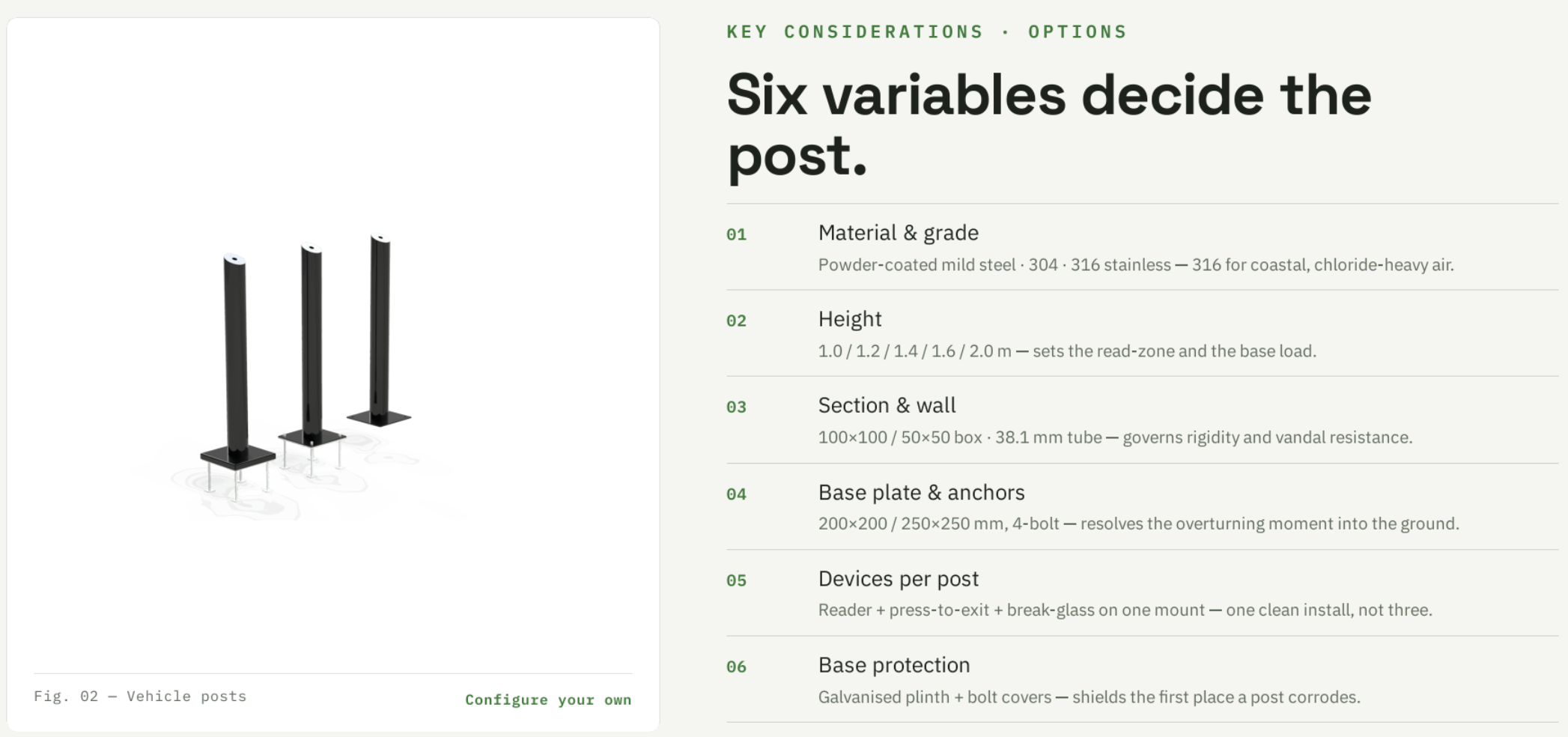
The six variables that define an access control post
When you specify a post, these are the variables that matter. Getting them right is the difference between a clean, long-lived install and a callback.
| Variable | Options | Why it matters |
|---|---|---|
| Material & grade | Powder-coated mild steel · 304 · 316 stainless steel | 316 resists chloride pitting in coastal and de-iced-road air; 304 suits inland sites; mild steel is cost-effective and colourable. |
| Height | 1.0 / 1.2 / 1.4 / 1.6 / 2.0 m | Sets the read zone for people or vehicles, and determines the load at the base. |
| Section & wall | 100×100 mm or 50×50 mm box · 38.1 mm tube | Governs rigidity and vandal resistance; wall thickness is what stops a post flexing under a mounted device. |
| Base plate & anchors | e.g. 200×200 mm or 250×250 mm, 4-bolt | Resolves the overturning moment into the foundation via the bolt pattern and concrete. |
| Devices per post | Reader + press-to-exit + break-glass + panel | Multiple devices on one mount give one clean install instead of three separate fittings. |
| Base protection | Galvanised plinth · bolt covers | Protects the base-to-ground interface — the first place any post corrodes. |
Gardner Engineering manufactures its posts in Britain from mild steel or stainless steel box section, fully cable-managed, with fixing holes that can be modified to suit your specific device at the point of order. See the Single Height & Dual Height Access Control Post for the 100×100 mm range.
How secure is an access control reader?
This is where the post itself becomes a security control. Three failure modes dominate the published research — and the middle one is the one good post design defends against directly.
1. Plaintext credentials
Legacy 125 kHz proximity cards and the Wiegand reader protocol transmit credential data unencrypted, which makes it possible to skim, clone and replay a card. Industry estimates suggest around 70% of physical access systems still run legacy 125 kHz prox, and such cards can be cloned in seconds with an inexpensive device, leaving no sign of forced entry — the logs simply show a valid entry.
2. Reader-tap implants exploiting exposed wiring
A reader sits on the unsecured side of the door, is not usually under continuous observation, and often has no tamper switch. That means the data wires behind it are reachable: a small implant wired to the exposed cabling can log and replay every badge presented. Installing it simply requires pulling the reader off the wall far enough to reach the wires. A post with full internal cable management, no accessible wiring and provision for a tamper switch removes the access this attack depends on. This is a genuine, evidence-based reason to care about how a post manages its cables — not marketing gloss.
3. Tailgating and undetected swaps
Following an authorised person through remains the most common real-world bypass, made worse where a removed or spoofed reader raises no alarm. Good positioning, camera line-of-sight, and dual-height vehicle lanes that keep drivers in their cab all reduce the opportunity.
What specifiers do about it: move off 125 kHz prox to encrypted credentials, adopt OSDP (an SIA and IEC standard that adds AES-128 encryption and, crucially, supervises the reader so tampering or removal is detected), design out exposed wiring with fully cable-managed posts and tamper switches, and layer authentication (card plus PIN or biometric) at high-value doors.
How long do access control posts last?
The honest, useful framing is that the post outlives the technology bolted to it. The steel is long-term infrastructure; the reader is a swappable, roughly 7–10-year consumable on its own upgrade cycle. Buy the post once, and re-fit the device for decades.
| Finish | Realistic service life | Best for |
|---|---|---|
| Hot-dip galvanised (or duplex) | 50–100+ years atmospheric; 20–40 years in marine/salt | The long-life route; inland and coastal infrastructure |
| Stainless 316 | 25–50+ years, no cosmetic degradation | Coastal and chloride-heavy sites |
| Stainless 304 | Structurally long inland; cosmetic pitting at the coast | Inland, non-marine environments |
| Powder-coated mild steel | Coating-dependent; recoat over years to a decade-plus | Budget-conscious, sheltered sites — best with a galvanised base |
Across every finish, the weak point is the same: the base-to-ground interface, where standing water and crevice corrosion attack the plate and anchor bolts first. A galvanised plinth lifts the base clear of standing water, and bolt covers protect the fixings — which is exactly why Gardner offers both as options.
Get these four details right
If you take nothing else from this guide, get these four right and the rest follows:
- Cables — specify full internal cable management. No exposed wiring means no reader-tap surface. Pair it with a tamper switch.
- Heights — mount the read zone at roughly 1.0–1.2 m for reach compliance under Approved Document M and BS 8300, and use dual-height on vehicle lanes so drivers stay in the cab.
- Materials — match the grade to the environment: mild steel or 304 inland, 316 stainless at the coast.
- Base — size the plate and anchors to the height and device load, and protect them with a plinth and bolt covers.
A note on mounting height and accessibility
Access control heights are set by Approved Document M (the legal minimum in England and Wales) and BS 8300:2018 (best-practice accessible design). A manual-wheelchair user has a comfortable forward reach of about 300–600 mm and a seated eye height of roughly 1000–1200 mm, and controls above 1200 mm become effectively unreachable from a seated position. Always measure to the centre of the read zone, not the body of the reader — and allow clear floor space in front of the post.
Gardner Engineering’s access control post range

All Gardner access control posts are designed and manufactured in Britain, fully cable-managed, and available in brushed stainless steel or powder-coated mild steel with an optional galvanised plinth and bolt covers. Fixing holes are modified to suit your device at the point of order, and multiple devices can share a single mount.
- Single Height & Dual Height Access Control Post — 100×100 mm box section, 1.2–2.0 m, with protective rain cowl.
- Single Height Tubular Angled Access Control Reader Post — 1 m angled post that presents the reader at the ideal angle.
- Single Height Angled Access Control Reader Post — 1 m angled reader post in stainless or mild steel.
Specify the exact post for your site.
Frequently asked questions
What is an access control post?
An access control post is a free-standing steel pedestal that holds a card reader, keypad or intercom at the right height and angle for people or vehicles to gain entry where there is no wall to mount to — at gates, barriers, car parks and building approaches.
What height should an access control reader be mounted at?
For accessibility under Approved Document M and BS 8300, mount the centre of the read zone at roughly 1.0–1.2 m above finished floor level, with clear floor space in front. On vehicle lanes, use dual-height posts so both car drivers and truck cabs can reach a reader without leaving the vehicle.
What is the difference between 304 and 316 stainless steel for access control posts?
Both look the same when new, but 316 contains molybdenum that resists chloride corrosion. Use 316 for coastal or heavily salted sites to avoid the pitting and “tea-staining” that can affect 304 outdoors near the sea; 304 is fine for inland, non-marine locations.
How long do steel access control posts last?
A hot-dip galvanised post can last 50–100+ years before first maintenance in normal atmospheric conditions, dropping to around 20–40 years in marine or salt-splash environments. The reader it carries typically lasts 7–10 years, so the post is best treated as long-term infrastructure and the device as a replaceable part.
Are access control readers a security risk?
The reader itself can be, mainly because it sits on the unsecured side of a door with its wiring behind it. Legacy 125 kHz cards can be cloned, and exposed reader wiring can be tapped. Using encrypted credentials and OSDP, and specifying fully cable-managed posts with a tamper switch, closes off the most common physical attacks.
Can the fixing holes be customised for my reader?
Yes. Gardner Engineering modifies the device fixing holes to suit your specific reader, keypad or panel at the point of order, and can mount several devices on a single post.